Sustainability
At Lund Opsahl, we recognize the critical role structural design plays in shaping the built environment’s carbon footprint. As engineers, we have a responsibility to lead with knowledge and transparency. That means using tools like our Sustainability “Nutrition” and Information Label” (SNAIL) to spark conversations about embodied carbon in our designs. We approach every project as an opportunity to align performance with purpose, integrating sustainability into the structural system from the start.
Our Strategies
Holistic Design
Our “Sustainability Nutrition Label,” now featured on our drawing covers, uses Revit with EC3 to spark carbon‑impact conversations and guide design decisions in real time.
Material Exploration
Our holistic approach balances project objectives, cost, constructability, environmental impact, load‑bearing requirements, schedule constraints, and the desired aesthetic.
Passive House, Zero Energy/Carbon
With strict thermal and energy guidelines, we leverage our experience with thermal‑break materials, energy‑envelope detailing, and rapid analysis to guide teams toward achieving ambitious performance goals.
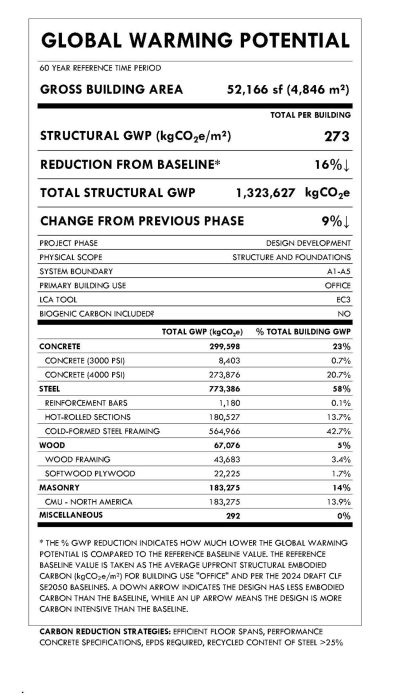
The SNAIL - an embodied carbon tool
We developed the Sustainability Nutrition and Information Label (SNAIL) to make carbon impacts part of the conversation from day one.
The SNAIL is a simple, intuitive reference label that appears on the cover of our drawing sets at major project milestones to highlight the embodied carbon of primary structural elements. By making this information visible and accessible, we aim to support our clients and design partners in making informed, intentional choices about structural systems and their environmental impact.
FEATURED PROJECT
Meet the LORECS
The Lund Opsahl Reducing Embodied Carbon & Sustainability (LORECS) team is responsible for planing and implementing our embodied carbon education curriculum and reduction initiatives.




SE 2050 Commitment
Lund Opsahl is a signatory firm for the Structural Engineers 2050 Commitment Program, which was developed by the Sustainability Committee of the Structural Engineering Institute (SEI) of the American Society of Civil Engineers (ASCE). We’re committed to understanding, reducing and ultimately eliminating embodied carbon in our projects by 2050. Our Embodied Carbon Action Plan outlines the steps we’re taking to net zero.